

How American-Made Wrench Design Affects Torque, Grip, and Clearance
A wrench can only perform as well as its design allows. Utility, pipeline, waterworks, construction, and industrial crews often work with heavy hardware, tight spaces, irregular surfaces, and components that need protection. A dependable American-made wrench needs to transfer force efficiently, maintain secure contact, and give the operator room to work.
Handle length, head geometry, opening shape, materials, and ratchet construction all influence performance. Understanding how these features affect torque, grip, and clearance helps workers choose the right wrench instead of improvising with a tool that doesn’t fit the job.
What We’ll Cover:
- Why wrench design matters
- How design influences torque
- What creates a secure grip
- Which features improve clearance
- How to match the wrench to the application
- Key takeaways
Why Wrench Design Matters in the Field
No single wrench design handles every application equally well. Fastener shape, workpiece material, available clearance, and required force all influence the choice. A poorly fitting wrench can slip, damage hardware, or waste time through repeated repositioning. Purpose-built tools give workers better control because the wrench matches the component, whether the job involves a square nut, finished pipe, threaded fastener, or valve wheel.
How Wrench Design Affects Torque
Torque is the rotational force used to tighten or loosen a fastener. Handle length affects leverage, while the wrench’s strength and rigidity determine how effectively that force reaches the workpiece. The ratcheting mechanism must also stay engaged under load so the operator can turn the hardware with consistent control.
Fit matters just as much as leverage. A socket wrench surrounds a nut or bolt and distributes force across its surfaces. A square wrench performs the same basic job on square fasteners commonly found in utility applications. When the opening matches the hardware, the worker can apply controlled torque with less movement between the tool and fastener.
More torque is not automatically better. The goal is to apply the appropriate amount of force without damaging the tool, fastener, or surrounding equipment.
How Wrench Design Affects Grip
Grip depends on the contact between the wrench and the workpiece. A properly sized socket wrench or square wrench engages defined surfaces securely. An opening that is too large can move around the fastener, increasing the risk of slipping or rounding the hardware.
Round and irregular components require a different approach. A strap wrench wraps around the workpiece and spreads contact across a wider area. When properly selected and positioned, it can grip pipes, fittings, and finished surfaces while reducing the risk of scratching, denting, or crushing them.
A valve wrench uses a purpose-built hooked head to engage a valve wheel. This design gives the operator additional leverage while maintaining controlled contact with the wheel.
Linemen need tough wrenches that can withstand the test of time. Trust Lowell to make your repairs easier.
How Wrench Design Improves Clearance
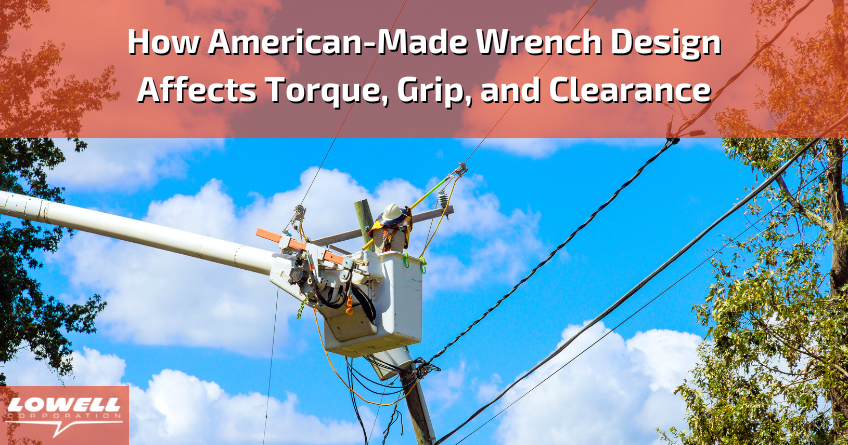
Fieldwork rarely happens on an open workbench. Linemen may be working from a pole or bucket, while waterworks and pipeline crews may need to reach hardware inside trenches, around fittings, or near other equipment.
Low-profile heads, short ratchet swing arcs, reversing mechanisms, and articulating designs can make a wrench easier to operate in restricted spaces. A bolt-through socket lets long bolts or threaded rods pass through the wrench head, removing the need for an extra-deep socket. These features help workers maintain engagement and complete a turn with fewer resets.
Clearance is not only about handle length. Head thickness, swing angle, socket depth, and surrounding obstacles all affect whether a wrench can reach and turn the hardware.
Matching the Wrench Design to the Application
Each typical American-made wrench design solves a different field problem. Choosing the correct one improves control and helps protect the component being serviced.
Socket Wrench
A socket wrench is designed for nuts, bolts, and other defined fasteners. Fixed or interchangeable sockets let workers match the opening to the hardware, while ratcheting action reduces repeated removal and repositioning.
Square Wrench
A square wrench engages square nuts, bolts, and utility hardware. Double-, triple-, or quad-square designs combine several common openings in one tool, helping linemen reduce tool changes.
Strap Wrench
A strap wrench works well on pipes, fittings, and round or irregular components. Its broad contact area provides grip without relying on jaws or teeth that could mark a finished surface.
Valve Wrench
A valve wrench is built to engage valve wheels and provide additional leverage. It is commonly used in waterworks, pipeline, industrial, and facility-maintenance applications where valves may be difficult to operate by hand.
What to Look for in an American-Made Wrench
An American-made wrench’s performance depends on more than its country of origin. Accurate openings, strong materials, reliable ratchet engagement, durable finishes, and readable size markings all contribute to field performance. Dimensional inspection, hardness verification, and torque testing help confirm that the finished tool meets its design requirements.
Manufacturing quality matters most for application-specific tools. Small differences in fit, alignment, or ratchet operation can affect how securely a wrench engages and how much control it provides under load.
Key Takeaways
- Handle length, material strength, and ratchet construction affect torque transfer.
- Proper tool fit improves grip and helps protect fasteners and components.
- Head profile, swing angle, articulation, and Bolt-Thru designs improve clearance.
- A socket wrench, square wrench, strap wrench, and valve wrench each serve a different purpose.
- The right American-made wrench should match the hardware, working conditions, and force required.
Ready to save time and money on
your lineman tools?
The Best American-Made Wrench Manufacturer Since 1869
Lowell Corporation offers the best industrial tools in the industry. Whether you need a crank handle or a valve wrench, your company deserves the right balance between cost and efficiency. Our custom hand tools make tough jobs easier for design engineers, waterworks engineers, and utility linemen. We’re proud to distribute J.L. Matthews lineman tools to support linemen nationwide.
We’ve been increasing construction, maintenance, and manufacturing productivity since 1869. Let our trusted socket wrench sets simplify your workload, no matter which strap wrench set you need. With our essential lineman tools, you get the backing of the most trusted name in the hand tool industry.
Lowell Corporation is proud to manufacture all of our hand tools in the U.S.A. in the heart of New England. All Lowell wrenches are 100% guaranteed with our one-year manufacturer’s warranty against defects in material and craft for one year from delivery.
Follow us on Instagram for exciting product updates and promotions!